Cleaner, Quieter, Safer and Slightly Smaller
In four words, that sums up the new truck for Sligro BS Amsterdam. It is a remarkable vehicle, as this Renault is equipped with important innovations in the areas of sustainability, safety and noise reduction. These features are particularly valuable for distribution operations in busy and confined city centres.
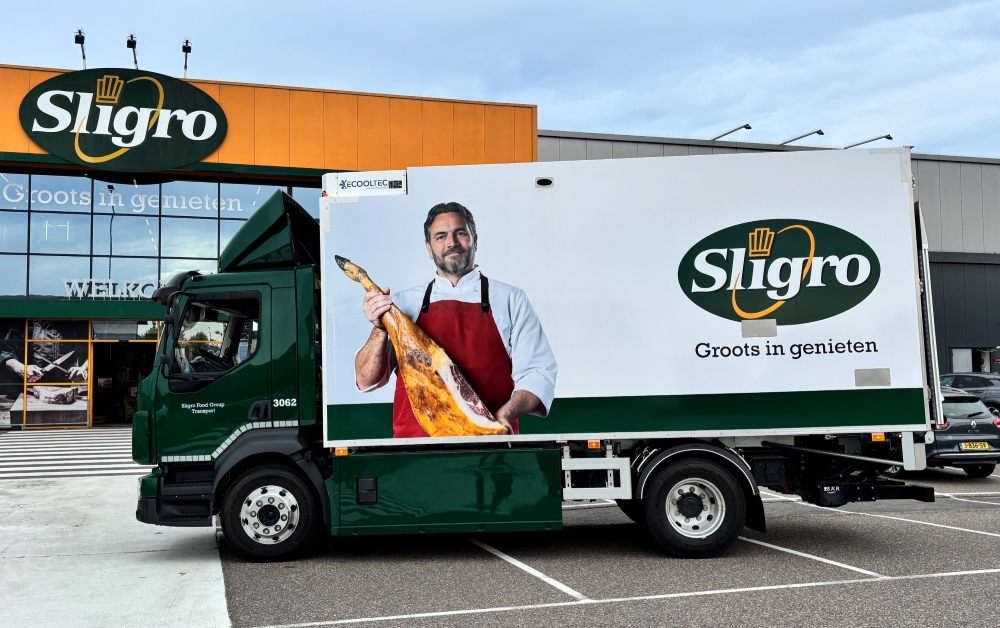
Cleaner
This is, of course, a 100% electric truck. But what makes this vehicle particularly special is its innovative refrigeration system, which offers a significant environmental benefit. It uses propylene as a refrigerant, a naturally occurring gas that causes no harmful environmental effects if it is accidentally released into the atmosphere.
Quieter
Refrigeration systems generate noise. Especially on sunny and warm days, they operate at full capacity and can produce significant sound levels. Precisely at those times when people are outdoors, sitting on café terraces, or sleeping with their windows open in the apartments above hospitality venues that Sligro supplies early in the morning.
In such situations, sound is often perceived as noise pollution, leading to annoyance and a lack of understanding among local residents. The refrigeration unit on this truck can truly be described as a “whisper-quiet” system. It keeps deliveries at the required temperature to ensure food safety while operating at significantly lower decibel levels than conventional refrigeration units.
Safer
The truck is equipped with multiple cameras all around the vehicle. While cameras themselves are nothing unusual, what makes this system truly innovative is that it is AI-powered.
The system assists the driver with a comprehensive view of the vehicle’s surroundings, including a bird’s-eye perspective. Using object recognition technology, it provides targeted visual and audible warnings when detecting vulnerable road users such as pedestrians and cyclists.
In addition, the truck is fitted with acoustic and visual warning signals to alert other road users during manoeuvring and unloading operations, further enhancing safety in busy urban environments.
Smaller
Most vehicles used for urban distribution have a capacity of 27 roll containers. This truck accommodates 18 roll containers. While this means a lower carrying capacity, it also makes the vehicle significantly shorter, which is a major advantage in the narrow and congested streets of city centres where manoeuvring can be challenging.
A shorter truck is easier to handle in confined urban environments and contributes to improved road safety by reducing risks for pedestrians and cyclists.